December 30, 2021

Scranton/Wilkes-Barre Red Barons - #22 Ed Yarnall (2004)

Having already poured it all out for the Scranton/Wilkes-Barre Red Barons in a previous post, this post will be less detailed.  At the same auxiliary souvenir stand at Lackawanna County Stadium that I bought the Darren Burton jersey — it was either called Stand 3A or 4A — I acquired what one would call a batting practice jersey.  Rather than a full set of front buttons, it is a two-button pullover style jersey.  It is indeed black, rather than the dark navy that accented all other Red Baron uniforms before and since.  The numbers are fire engine red as opposed to maroon.  While the Phillies updated their uniforms and color scheme in 1992, the Red Barons waited until 2003 to match their shade.  I am unsure if I purchased it on an April 2005 visit to the ballpark (I think so), or at the 2006 home opener (less likely).

Until twenty minutes ago, I was prepared to give up on identifying the player this was issued to.  I dug through old baseball card sets and team photos.  I figured out that Gavin Floyd wore #21, Dan Giese #23, and Shawn Wooten #24 in 2004.  I've struggled to determine who, if anyone, wore this in games, so I've called it team issued for the time being.  Scant evidence exists that these tops were ever worn by players as the Red Barons notoriously rarely wore alternates in games.  These Gavin Floyd pictures taken by Four Seam Images in Rochester prove their existence though additional photos from game action that same day show the Barons suited up in classic greys.  This photo of Ed Yarnall from earlier in the season seems to have answered the question.  The two inches of extra length for a six-foot, four-inch pitcher certainly checks out.  Some conflict persists.  His baseball card from that season shows Ed wearing a #51 home jersey.  Since we're calling it a Team Issue anyway, let's go with it.  

Looking back to my golden era of minor league baseball, I mostly think of Yarnall as one of the most dominant starting pitchers during the International League's 1999 season.  The Columbus Clippers were the strongest team in the league in terms of regular season and Ed was their ace.  His 3.47 ERA was almost two runs better than any of the other Clipper rotation mainstays who made 20 starts.  Five years later, with seven major league appearances and a trip to Japan sandwiched between, Yarnall took the mound wearing a different set of pinstripes.  Ed would bounce around AAA for a few more years, winding down his professional career in familiar fashion, the last season split between the Mexican League and independent ball.

Details:
  • Manufacturer - Russell Athletic
  • Size - 48 (2" Extra Length)
  • Date Acquired - Unknown
  • Authentic Team Issue - Nylon excluding trim
  • Two-color Twill Script/Numbers
  • Issued for 2004 Season

December 29, 2021

Ottawa Lynx - #19 Jim Rushford (2007)

Having grown up in one AAA town and moved to another, I was quite familiar with the Ottawa Lynx and their noted attendance woes.  As always, and as I would find out, there is more to the story than simple lack of support.  In 2007, the team was purchased by interests in Eastern Pennsylvania, who announced plans to move it to Allentown for the 2008 season.  Naïve to what this actually meant to the Ottawa baseball community, I planned a trip to see the last two games in Lynx history.  Before our trip, I saw a newspaper photo of the Lynx in their road greys, which I thought looked great, and which I would try to buy if possible when visiting.  Sure enough, in an effort to recoup any losses possible, the team store was selling the road uniforms during the last homestand in team history.  As I recall, this was the most expensive jersey I'd purchased to date, and is likely still among the most expensive few.  The U.S. dollar was worth $1.05 CAD that day and by the end of the month, the Canadian dollar would be worth more than its U.S. counterpart for the first time in 30 years.

Jim Rushford was signed as an undrafted free agent by the Brewers in 2000 from San Diego State University.  As the Lynx affiliation was switched to Philadelphia for their final year in anticipation of moving the Phillies AAA to the Lehigh Valley, Jim had spent most of the previous three years playing in Scranton (there it is).  Before his Red Baron days, Rushford made it to Milwaukee in 2002 where he'd make 84 plate appearances in his only major league action.  After his age 33 season in Ottawa, Jim spent a very abbreviated 2008 season in the Mexican league before wrapping up with Tucson Toros of the independent Golden League.

The Lynx were born of the early 90s Canadian baseball mania culminating in back-to-back Toronto championships and the elite 1994 Montréal Expos team.  As Miami and Denver added to the major league ranks in 1993, Charlotte became a AAA city along with Ottawa, who hosted the Expos top prospects in front of 9,764 per night at brand new JetForm Park.  1995 saw the Governor's Cup head north for the first time since 1966 as the Lynx defeated the Norfolk Tides three games to one.  While still drawing almost 7,000 per game, a combination of the luster wearing off and perennial subsequent losing teams began to depress attendance.  As I understand it years later, the coup de grâce occurred when a solid third of the parking lot on the entrance side of the ballpark was consumed to build a pair of hotels and a conference centre.  Knowing me, and knowing Ottawa, I wouldn't consider this an excuse.  After all, Ottawa pioneered the busway system and boasted a nearly 20% pre-pandemic public transit mode share.  Unfortunately, the Tremblay busway station was located across a 400-series expressway (think Interstate in the U.S.).  A long discussed pedestrian bridge would not materialize in time to make a bus to the ballgame a convenient enough option for enough of the potential fanbase.  The Lynx lost to Syracuse on September 3, 2007, in front of 7,461.  I will never forget how sad a scene it was and how badly I still feel about how I acted at the funeral.  Ottawa would go on to host other levels of professional baseball at the same park, a topic I will cover in a future post.

Details:
  • Manufacturer - Rawlings
  • Size - 48
  • Date Acquired - 9/2/2007
  • Game Worn - Polyester
  • Two Twill Script/Numbers
  • Away Jersey for 2007 Season

March 21, 2021

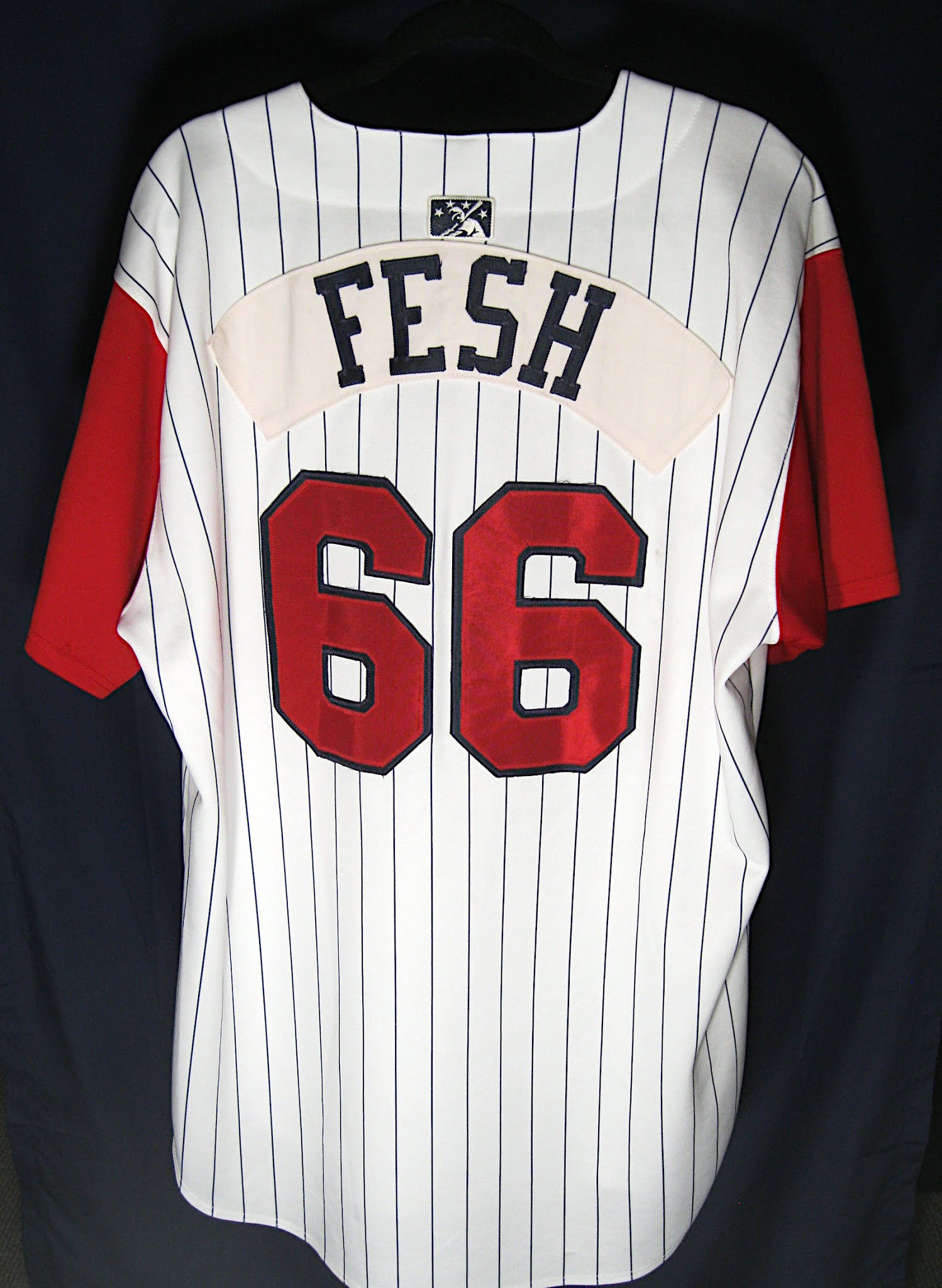
Scranton/Wilkes-Barre Red Barons - #66 Sean Fesh (2005)

Approaching the 2005 holiday season, I had a conversation with Mike Cummings, Public Relations Director for the Scranton/Wilkes-Barre Red Barons.  He said I'd need to act quickly and pay up front what I considered at that time to be a sizable amount in order to hold a jersey worn the previous season by a relief pitcher who pitched there the previous summer.  While visiting family that December, I was able to pick up the jersey.  What's the story here?  Settle in.

In the early spring of 1999, Mark Bechtel of Sports Illustrated wrote a short season preview piece in Sports Illustrated entitled, Phillies: A Fesh Face in the Bullpen.  Within, Bechtel told the story of a 26-year-old lefthander named Sean Fesh who just wouldn't quit.  Having missed most of the 1996 season due to elbow ligament surgery, Fesh was released by the Mets at the end of a modest 1997 season spent in AA.  Sean developed a new sidearm throwing motion that increased his velocity and movement and attempted to earn tryouts throughout the summer of 1998.  A fateful drive from his Connecticut home to Scranton would unknowingly alter the course of both of our lives.  There to see former teammates, Sean brought along his father who was able to request a tryout from Dallas Green on Sean's behalf.  Days later the Phillies offered him a minor league contract.  He responded by striking out 41 in 33 innings and was promoted to Scranton.  

Fast forward to May 21, 1999.  Friends and I attended a Red Barons game versus the Durham Bulls.  Fesh was brought in from the bullpen.  In the words of my friend Don, "This guy Fesh came in, he was hammering away, he looked good and we thought it would be fun."  "It" would involve us becoming Red Baron super fans for the better part of two summers, with Sean Fesh as the player at the center of our baseball bond.  Witty posters were hand drawn in marker, a very crude website (we called them homepages back then, lol) was created for our irreverent takes, and we were written about in the Sunday Times.  While we pissed some people off, we had our backers amongst the ushers and the front office.  In those days, the ushers left at the 7th-inning stretch or 9:30PM, whichever came first.  This was our cue to move into the front row behind the home on-deck circle and unleash verbal hell on opposing batters and pitchers.  And the team won.

For only the second time in their eleven season history, the Red Barons posted a winning record.  While it was only the 5th best record in the league, it placed them squarely in a three-way dog fight with the Syracuse Skychiefs and Pawtucket Red Sox for most of the summer.  It was an interesting team, scoring only 13 more runs that it allowed, but a team that fought back on countless nights after being put in a hole by subpar starting pitching.  After noted major league pitcher Randy Wolf was promoted early in the year, the Red Barons featured only one other start with an ERA under 4.5.  This meant bullpen arms like Fesh, Billy Brewer, Joe Grahe, and Steve Schrenk had to hang in there while batters like Wendell Magee, Torey Lovullo, Billy McMillon, and Jon Zuber bashed away to the tune of 800+ OPS in what was quite a pitchers park.  Time and time again the Red Barons pulled off the improbable, culminating in Game 3 of the first round of the 1999 Governor's Cup Playoffs.  Fan club members made their way back to Scranton from college campuses across the northeast to witness one for the ages.  The first home playoff game in Scranton since 1992 had it all.  Charlotte took an 8-2 lead in the fifth, aided by a pair of errors by rehabbing shortstop Desi Relaford, but the Red Barons scored two in the sixth, three in the seventh, and two in the 8th on a two-out triple off the right field wall by Bobby Estalella.  The top of the 9th was white knuckle time.  Quoting Times reporter Randy Yanoshak, "Pay for the whole seat, but use only the edge, and all 6,636 at the stadium did."  Charlotte loaded the bases with no outs against reliever Darryl Scott.  Top prospect Pat Burrell, called up expressly for playoffs to reinforce holes left by September recalls like Lovullo, found himself playing first base in that 9th inning.  With the infield in, former Red Baron Dave Hollins smoked a line drive in Burrell's direction, which he successfully stabbed for the first out.  Finding some fight, Scott beared down to strike out Jeff Abbott before Darren Burton ranged a long way into the spacious foul territory at Lackawanna County Stadium to run down a foul ball off the bat of the dangerous Luis Raven.  In the bottom half, a fired up Burton would lead off with a double.  The next batter would sacrifice bunt him to third.  Relaford, the potential goat, stepped to the dish and laced a low liner to right field.  Chad Mottola slid, but couldn't snag it.  Unsure whether the ball would be caught, Burton got a late break to the plate.  Mottola's throw was strong to catcher David Toth who was unable to apply the sweep tag to the diving Burton, putting the exclamation point on the greatest baseball game I ever saw.  

Alas, this would be the last win the 1999 Red Barons would experience.  They dropped the next two of the best-of-five game series to the eventual league champions.  The fan club went its separate ways until it was reunited the following spring.  The team was more talented, but as is always the case, the vibe wasn't the same.  Sean Fesh put together perhaps the finest AAA season of his long career, but he and the club suffered a stomach punch in mid-July when he was traded to the Colorado Rockies.  The wild-card Red Barons would go on to upset a strong Buffalo team in the first round of the playoffs before falling in the finals to Indianapolis.  Sean Fesh would go on win a Southern League championship in 2003 with the Carolina Mudcats and post what may have been a better AAA season in 2004 with Richmond, but was not rewarded with a call to the big leagues.

This jersey?  Oh yeah.  The jersey represents a unique look in Red Barons history. In 2003, the Red Barons switched their primary color from what had been a brick red to a primary red in order to harmonize their look with the parent Phillies.  In 2005, the home whites would add red sleeves.  Long before that season got underway, one more chapter was written in this story that encapsulates my bonds with baseball.  In November of 2004, the Red Barons official website reported the news that Sean had re-signed with the Phillies organization.  Later in March, Van Rose of the Wilkes-Barre Times Leader wrote a story entitled Home Sweet Home, explaining Sean's desire to return to the Phillies organization.  On the field, Sean struggled and was sent to AA Reading in June.  I was fortunate to be able to catch up with him that summer in Syracuse, Rochester, and Erie.  He finished his professional career over the following two seasons closer to his Connecticut home with the independent Bridgeport Bluefish.

Details:

  • Manufacturer - Russell Athletic
  • Size - 48 (2" Extra Length)
  • Date Acquired - 12/2005
  • Authentic Game Worn - 100% Polyester
  • Two-color Twill Script/Numbers
  • American Flag on Sleeve
  • Worn in 2005

Pittsburgh Pirates - #37 Mike Johnston (2003)

In March of 2011, I was nearing the end of my first curling season.  As was tradition at the time, each April a bus of curlers from Pittsburgh would visit Rochester for a single day of friendly competition.  Wanting to show a welcoming spirit and a nod to my Pennsylvania roots, I purchased this to wear while curling against the yinzers.  It was the first of what became many purchases from the esteemed Kruk Cards described in the previous post.

Mike Johnston was a 20th Round pick of the Pirates in 1998 out of tiny Garrett College in McHenry, Maryland.  A six-foot three Pennsylvania boy, Mike would eventually see big league time in 2004 and 2005 with Pittsburgh before taking two years off (I assume a significant injury?) and subsequently winding down his professional career with the White Sox organization and the Lancaster Barnstormers of the Atlantic League.

The manfacturer's tagging is on the inside of this jersey.  Attached is a simple nylon tag with 2003 printed on it.  As Mike spent that season in Altoona, I imagine he was added to the 40-man roster in his sixth season of professional baseball.  This was likely prepared as a matter of course in case he made the jump that season.  The jersey is pristine, showing no signs of use as expected, and features no patches being vest-style.  I mentioned Mike's height earlier, which makes this one of my worst fits (I am 5'11").  For too long, growing up in the 90's made me think I wore size extra large shirts.  That's a stretch.  Once I've caught up on the jersey blog, I will likely sell this piece and try to purchase a sleeved road Pittsburgh jersey in size 46. 

Details:
  • Manufacturer - Majestic
  • Size - 48
  • Date Acquired - 3/10/2011
  • Authentic Team Issue - 100% Polyester
  • Two-color Twill Script/Numbers
  • No Patches
  • Issued in 2003 per internal tagging

Seattle Mariners - #57 D.J. Mitchell (2012)

At the end of May 2014, I was about to give notice at my job of ten years and start the hard portion of a career change that involved some relocation and vast fluctuations in income and savings.  As such, this is the last jersey I would purchase for over two years.  I actually first purchased a different navy Mariners jersey first, one with Seattle across the front belonging to Luke French, but sold it very quickly as it was far too large and the style wasn't very interesting.  This jersey was another purchase from Kruk Cards, an incredible card and memorabilia warehouse in Michigan, permanently linked in the sidebar.  Typically, this vendor seems to acquire full lots of similar jerseys direct from MLB teams. I don't recall exactly why I chose D.J. Mitchell.  I imagine it simply had to do with size and cost as the purchase price was exceedingly good.

D.J. Mitchell was a 10th Round draft pick of the Yankees in 2008 out of Clemson University.  He played parts of three seasons in Scranton before appearing in four major league games for the Yankees in 2012.  On July 23 of that season, Mitchell was one of two pitching prospects sent to Seattle for the great Ichiro Suzuki.  D.J. was immediately optioned to Tacoma and designated for assignment during that offseason.  He would not pitch in the major leagues again and finished his professional career in the Atlantic League.

This is the first jersey in my collection featuring the Major League Baseball Authentication Program hologram and lookup number.  This is a nice third-party authentication feature that greatly simplifies provenance research.  As Mitchell did not appear with the Mariners after the trade, it easy to say this jersey is Team Issued, but the confirmation, right down to the date worn, will come in handy on some of my other jerseys.  The jersey features an interesting metallicized silver twill that really pops in strong lighting.  There are no sleeve patches or tagging on this batting practice jersey, designed similarly to the spring training jerseys of that time.

Details:
  • Manufacturer - Majestic
  • Size - 46
  • Date Acquired - 5/20/2014
  • Authentic Team Issue - Polyester / Spandex Mix
  • MLB Hologram: EK209093
  • Three-color Twill Script
  • Two-color Name/Numbers
  • Batting Practice Jersey for 2012 Season

March 01, 2021

Tucson Sidewinders - #19 Unknown (2003)

In April 2004, less than two months away from graduating from engineering school, my senior design team went to Tucson to take part in the 8th International Micro Air Vehicle Competition (spoiler alert: we didn't win).  I suppose we were part of the trial-end-error process that led to drone photography.  On the last day we were in Arizona, the rest of my team went golfing and wound up in Mexico.  I, on the other hand, saw that the Tucson Sidewinders were playing the Tacoma Rainiers at Tucson Electric Park.  This would be my first and still the only Pacific Coast League game I have ever attended.  Six years later, an eBay user auctioned off one of what he claimed were many Sidewinder vest-style away jerseys.  I either missed or lost the auction, but subsequently e-mailed the seller to ask about his additional inventory and got a ludicrously good deal on this one.

I've struggled to determine who, if anyone, wore this in games, so I've called it team issued for the time being.  My only clue that it was at least issued during the 2003 season comes from the patch pictured below.  I was able to find my game program from 4/11/2004, looking for clues, but no one was listed wearing #19 early in the 2004 season either.  The 2003 Sidewinders boasted Brandon Webb, Lyle Overbay, and Rod Barajas at one time or another.  I can say with certainty this didn't belong to them.  There are more than a few players who could have worn it, perhaps the owner of this knows.  If anyone out there has any insight, please let me know!

This was the first vest-style jersey that I purchased.  The placement Pacific Coast League 100th Anniversary patch is interesting, but I suppose it speaks to the inability to place sleeve patches on a vest. It also precludes possible use by the team in 2004.  The Sidewinders are another team that no longer exists.  Previously known as the Toros, they were renamed and the color scheme changed to relect Tucson's relationship with a new parent, the expansion Diamondbacks.  Tucson Electric Park was part of a pair of Cactus League stadia removed from Metro Phoenix.  When I attended the game in 2004, it had just finished hosting the D-backs and White Sox for the spring.  Following the 2008 season, the team moved to Reno to escape attendance woes and became the Aces.

Details:
  • Manufacturer - Rawlings
  • Size - 46
  • Date Acquired - 9/7/2010
  • Authentic Team Issue - 100% Polyester excluding trim
  • Three-color Twill Script/Numbers
  • Chest Patch
  • Issued for 2003 Season

February 26, 2021

Batavia Muckdogs - #11 Paul Vasquez (2007)

In April 2008, the Rochester Business Journal announced that the "Rochester Red Wings began their 2008 season this week in partnership with the Batavia Muckdogs, with the teams sharing resources in marketing, sales and concessions."  As part of the deal, for each year that Rochester Community Baseball managed the Muckdogs, they'd acquire 5% equity in the eventual sale of the team.  Another part of the deal saw the Muckdogs play two games at Frontier Field, home of the Red Wings, that summer.  While hosting Batavia early in what became a New York-Penn League championship season, a Muckdogs team store was set up in the old firehouse integrated into the left field corner.  As #11 was my number my last year playing organized ball, and I still thought I should be wearing extra large shirts (hard to beat the 90s out of me), I chose this one.

Paul Vasquez was an undrafted catcher out of Auburn-Montgomery who hung in there for three seasons in the Cardinals system.  If he was really 5'10"-160, this must have fit like a blanket (I'm 5'11"-180).  Promoted to Quad Cities the following year, Paul hit a ton and earned another promotion to Palm Beach where it appears he hit the wall offensively.  After a 2009 season with a nearly ten-to-one strikeout-to-walk ratio and a rehab stint in the Gulf Coast League, Paul hung them up for good.

As there was no name on the back, it's possible this jersey was worn in seasons prior to 2007.  The jersey is in pretty good shape, which jives with 31 games of use, so perhaps it wasn't used for multiple seasons.  There are no sleeve patches or tagging beyond the manufacturer tag.  This is the first jersey profiled for a team no longer part of professional baseball.  Major League Baseball took control of the minor leagues in 2001 and discontinued all short-season leagues.  An apparent reincarnation of the team has since joined the Perfect Game Collegiate Baseball League.

Details:
  • Manufacturer - Rawlings
  • Size - XL
  • Date Acquired - 6/20/2008
  • Authentic Game Worn - 100% Polyester
  • Two-color Twill Script/Numbers
  • No Sleeve Patch
  • Worn in 2007, possibly earlier

February 25, 2021

Scranton Wilkes-Barre Red Barons - #18 Darren Burton (2000)

During the summers of 1999 and 2000, I likely attended 100 Triple-A ballgames, the vast majority at Lackawanna County Stadium in Moosic, Pennsylvania, just minutes from where I grew up.  In 1999, the Red Barons won the International League North Division for only the 2nd time in their history, and for the first time since 1992.  Darren Burton slotted in as the full-time right fielder on that improbable division winner, a team adept at climbing out of the holes their poor starting pitching put them in.  On a visit home from college early in the 2001 season, the auxiliary souvenir shop at the stadium was selling previous year jerseys relatively cheap (on the order of $35-40).  This was the first double-knit game worn I ever purchased, with no thought that it would ever turn into a collection.  I don't recall what others were for sale or why I chose Darren's jersey aside from familiarity with his play in Scranton over parts of four seasons.

Darren was something of a sparkplug, a high-energy grinder at the Triple-A level.  Listed at 6'1" (unlikely), Darren was drafted in the 5th Round of the 1990 draft by the Royals immediately after being named Mr. Baseball in the state of Kentucky on the strength of his senior season at Pulaski County High School.  He steadily moved up the ranks, putting together his strongest AAA season at Omaha as a 23-year-old in 1996.  Following that season he was selected in the minor league portion of the Rule V Draft by Philadelphia.  Assigned to Reading initially, Darren dominated in 45 games before being promoted to the Red Barons.  In 1998, he tied the franchise home run record with 18 in 117 games (LCS was a strong pitcher's park despite the first generation turf field).  It appears Darren did not last long with the 200 edition of the Red Barons before finding himself in Altoona in the Pirates organization for the remainder of his professional career.  Darren may or may not have bought shots of Goldschläger for a bunch of kids 22 years ago.

Given no name on the back, it's not clear if this jersey was worn for multiple seasons.  The road pinstripe design is interesting.  As of 2019, no major league teams wore pinstripes on the road.  In 2020, the San Diego Padres brought the design back.  Back in 2000, five teams (Colorado, Arizona, Pittsburgh, Anaheim, and Minnesota) went with pinstripes on grey.  The jersey is in good shape, but features no interesting tagging or sleeve patches, a rather minimal minor league road look.

Details:
  • Manufacturer - Russell Athletic
  • Size - 46 (2" Extra Length)
  • Date Acquired - 2001
  • Authentic Game Worn - 100% Polyester
  • Two-color Twill Script/Numbers
  • No Sleeve Patch
  • Worn in 2000, possibly earlier

February 14, 2021

Toronto Blue Jays - #36 Bob File (2003)

In April 2004, roughly a month before graduating from college, I joined friends from high school, college, and my future wife on a weekend trip to Toronto.  By this time, I knew I'd remain in Rochester after graduation as I was offered a job with the local division of Harris Corporation.  After a ten-year period of caring about the minor leagues far more than the major leagues, and noting that Toronto was significantly closer to my new home (sorry Pittsburgh and Cleveland!), I decided around this time that I would become a Blue Jays fan.  I certainly wasn't entering at a high point.  My friends and I witnessed a decent game, decided for the Orioles by a Larry Bigbie homerun in the Top of the 9th, but that edition of the Blue Jays would go on to lose 94 games, including a few more I'd see that year.  On our way out of the SkyDome, as it was still called, and on our way to drink the largest pitcher of beer I've ever seen at the Peel Pub, we stopped in the team store and bought this jersey.

Bob File was a big boy, a 6'4" 210 pound relief pitcher, and like me originally from Pennsylvania.  Drafted out of Thomas Jefferson University in the 19th round, Bob made quick progress through the minor league ranks.  He reached AAA Syracuse in only his 3rd season in professional baseball, yet dominated.  He allowed only two earned runs and two walks in 19.1 innings.  It appears another quick minor league start propelled Bob to 60 major league appearances in 2001.  It appears that the wheels fell off to some degree in 2002 and injuries must have gotten him during 2003, the year this jersey was intended to be used, and the last year that the Blue Jays wore this style before switching to a white, blue, and silver scheme.

The jersey is in excellent condition as one might expect for a game-issue.  It served as my introduction to embroidered team tagging, a practice that has sadly fallen out of favor in recent years, but to me is still part and parcel of the world of game work jerseys.  A close inspection shows that the central red line through each letter and number is actually a very thin piece of tackle twill, individually stitched.  Also worth a look is the sleeve patch.  The muscular bird hugging the T was actually the team's primary logo in 2003 after being introduced as an alternate logo in 2001.  It always looked a little too similar to the Texas Rangers T to me.

Details:
  • Manufacturer - Majestic
  • Size - 48
  • Date Acquired - 4/17/2004
  • Authentic Team Issue - 100% Polyester
  • Three-color Twill Script/Numbers
  • Left Sleeve Patch
  • Issued for 2003 Season


October 31, 2010

Scranton Miners - #50 Joel Bennett (1999)

June 20th, 1999 saw the Scranton/Wilkes-Barre Red Barons face off against the Columbus Clippers in a turn-back-the-clock game.   The Scranton 'Miners' walloped the Columbus Redbirds 7-1.  The Red Barons were portraying the 1953 Scranton club, a Washington Senators affiliate in the Eastern League that was the last professional baseball team to call the city home before the 36-year drought was ended in 1989.  Columbus was representing a St. Louis Cardinals affiliate from the old American Association.

Having just graduated from high school days earlier, I was flush with cash (for those days), and in a position to acquire this jersey in a silent auction.  While some friends went in on a #66 Sean Fesh uniform, I wanted clear title to one, but was generally limited to players who I'd win the auction on with the minimum bid of $100.  This auction was for the entire uniform and included game pants and a cap.  More on that later.

Joel Bennett was a right-handed pitcher who enjoyed enough success in 1998 and 1999 to see time with the Orioles and Phillies respectively.

The jersey is in pretty good shape since Mr. Bennett did not take the hill that day.  There are what appear to be tobacco stains near the top button.  The pants that came with the jersey certainly did not belong to Joel.  Upon acquisition, there was a significant accumulation of dirt on one hip from sliding.  There are no number or players tags in the pants however.  The hat was brand new and was likely not one issued to the players.

While I cannot find a boxscore for the game, the old Sean Fesh Fan Club archives state that Wendell Magee and Darren Burton hit homeruns as Rodney Bolton and Ryan Nye turned in outstanding pitching performances.

Details:
  • Manufacturer - Maple
  • Size - 48
  • Date Acquired - 6/20/99
  • Authentic Game Worn - 65% Acrylic/35% Wool, Embroidered Script/Numbers, No Patches/Name On Back
  • Season(s) Worn - 1999 (replicating 1953)

September 11, 2010

Soviet Union - #10 Viktor Belyakov

As I begin to chronicle the collection, I've decided to do it as chronologically as possible. These were the days when I was only ever given jerseys as Christmas gifts or for other unique occasions.  I no longer know the whereabouts of many of these jerseys, including early 1990's New York Islanders and Vancouver Canucks jerseys of reasonable quality for the time.

This design seems to still make appearances on eBay, yet I've found no proof that the Soviet Union National Team ever wore this design, that Viktor Belyakov ever played for the Soviet National Team, or which Viktor Belyakov this is supposed to be.  It turns out that two Viktor Belyakovs, both forwards, were prominent Russian hockey players toward the end of the Soviet regime.  Interestingly, both were playing in the 2nd tier Russian at about the same time.  Belyakov the younger would go to greater national league prominence after deunification.

As much as I've learned already from the hobby, attempting to gain a greater understanding of the origins of this piece took me somewhere I never thought I'd be, getting a crash lesson on and translating the Cyrillic Alphabet.  In case you are interested in how BELYAKOV comes from БEЛЯКОВ, our capital B is their V sound.  The truncated B is the Russian B sound.  This leaves the pi-like symbol and the backwards R, which are an L and a 'YA' sound respectively.  I wonder what my mid-to-late 90's school teachers, likely Cold War weary, thought as their students sported CCCP across their chests like it was no big deal (which it wasn't and isn't, of course).

*UPDATE - I eventually sold this jersey in November of 2018.

Details:
  • Manufacturer - Unknown
  • Size - XL
  • Date Acquired - Unknown
  • Cost - Unknown
  • Low-Quality Replica - Mesh Polyester, Printed Numbers
  • Season(s) Worn - Unknown
  • Player - Not Game Worn
  • Patches - None